
Winning Real Estate & Property Management Clients with Digital Proposals
Learn how to create a professional property management proposal that showcases your services, fees, timeline, and property expertise—and win more clients with a modern digital proposal.
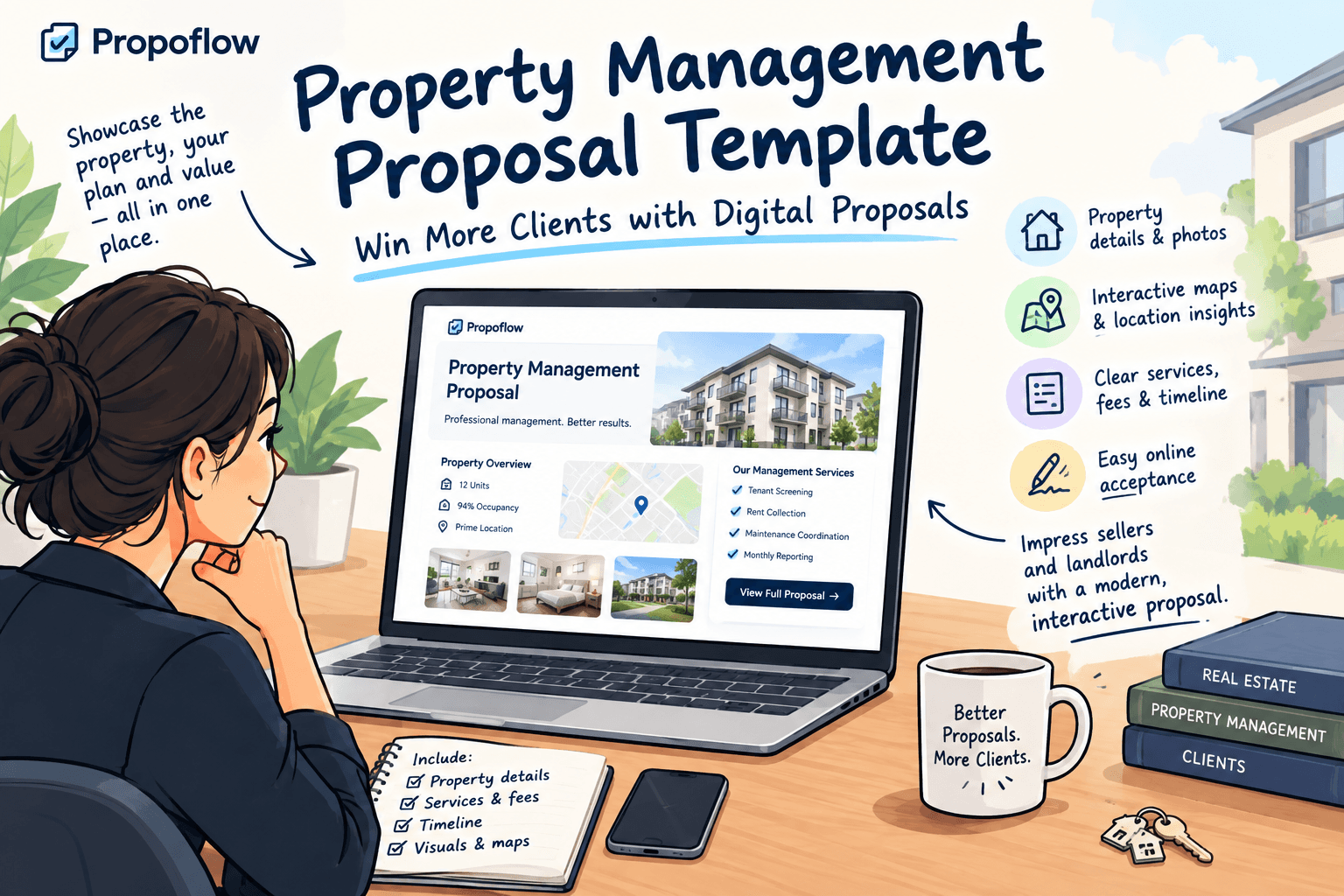
Winning Real Estate & Property Management Clients with Digital Proposals
Winning a new property management client often comes down to one thing: convincing a property owner that your agency can manage their property better than the alternatives.
That means your proposal needs to do more than list your services and fees.
It needs to show the owner that you understand the property, have a clear management plan, and can make their life easier.
A well-structured property management proposal can help you communicate all of that before the first contract is signed.
And instead of sending a static PDF that gets buried in an inbox, a digital proposal gives you a chance to create a polished, interactive experience that is easy to review and accept.
What Is a Property Management Proposal?
A property management proposal is a document or online presentation that explains how your company will manage a property and what the owner can expect from your services.
Depending on the property and client, the proposal may cover:
- Property details
- Your management services
- Marketing strategy
- Tenant screening
- Rent collection
- Maintenance and repairs
- Communication and reporting
- Fees and commissions
- Contract terms
- Implementation timeline
The goal is simple:
Show the property owner exactly what they are getting, how you will deliver it, and what it will cost.
What Should a Property Management Proposal Include?
A strong proposal should answer the questions a property owner is likely to have before hiring you.
1. Property Overview
Start by demonstrating that you've actually looked at the property.
Include relevant information such as:
- Property type
- Number of units
- Location
- Current condition
- Occupancy status
- Key features
- Relevant property photos
For a sales or management pitch, this section can immediately make your proposal feel more personalized.
Instead of sending the same generic proposal to every prospect, show them that this proposal was created specifically for their property.
2. Your Understanding of the Owner's Goals
Different property owners have different priorities.
One owner may want to maximize rental income.
Another may care more about minimizing vacancy.
Someone else may want a completely hands-off management experience.
Address those priorities directly.
For example:
Your primary goal is to maintain consistent occupancy while reducing the amount of time you personally spend handling tenants, maintenance requests, and rent collection.
That is much more persuasive than simply saying:
“We provide professional property management services.”
3. Property Management Services
Clearly explain what you will handle.
Your services might include:
Tenant management
- Tenant inquiries
- Application processing
- Screening
- Lease coordination
- Tenant communication
Financial management
- Rent collection
- Owner payments
- Monthly statements
- Expense tracking
Property maintenance
- Maintenance requests
- Vendor coordination
- Inspections
- Emergency response
Marketing
- Listing creation
- Photography
- Property advertising
- Lead management
Avoid vague statements such as:
“We handle everything.”
Define what “everything” actually means.
Clear deliverables make your proposal easier to understand and reduce the chance of disagreements later.
4. Marketing Strategy
For vacant properties, owners want to know one major thing:
How will you find qualified tenants?
Explain your approach.
You could include:
- Listing platforms
- Property photography
- Listing optimization
- Lead response process
- Showing process
- Applicant screening
- Follow-up process
For a real estate sales proposal, you can instead explain your marketing plan for attracting buyers.
The more specific the strategy, the easier it is for the client to understand the value of your service.
5. Fees and Commission
Your pricing should be easy to find and easy to understand.
Depending on your service, this might include:
- Management fee
- Leasing fee
- Renewal fee
- Maintenance coordination fee
- Advertising costs
- Additional services
For example:
ServiceFeeMonthly property management8% of collected rentNew tenant placement50% of first month's rentLease renewal$150Emergency maintenance coordinationAs needed
Your actual pricing will depend on your market and business model.
The important thing is transparency.
A property owner shouldn't have to search through several pages to figure out what your service costs.
6. Timeline
Show the client what happens after they say yes.
For example:
Day 1–2: Property onboarding
Day 3–5: Marketing materials prepared
Day 6: Property listing published
Week 1+: Lead generation and showings
Upon approval: Tenant onboarding
For an existing rental property, your timeline could instead cover the transition from the current manager to your company.
A timeline turns your proposal from a sales pitch into a plan.
7. What Makes Your Agency Different?
The client is probably comparing multiple agencies.
Use your proposal to explain what makes your approach different.
That could be:
- Faster response times
- Better tenant screening
- Better reporting
- Local market expertise
- Technology
- Transparent fees
- Specialized property experience
- A dedicated point of contact
Keep this focused on outcomes rather than empty claims.
Instead of:
“We're the best property management company.”
Try:
“Owners receive a monthly performance report covering occupancy, rent collection, maintenance expenses, and outstanding issues.”
The second statement gives the client something concrete to evaluate.
Make Your Proposal More Visual
Property is inherently visual.
Your proposal should take advantage of that.
Include relevant visuals such as:
- Property photographs
- Floor plans
- Market charts
- Branding elements
- Before-and-after images
- Maps
- Local market information
A property owner is far more likely to engage with a proposal that visually presents the opportunity than a wall of text.
Use Maps to Add Context
A simple map can make a proposal feel significantly more personalized.
For example, you could show:
- Property location
- Nearby schools
- Transportation
- Shopping
- Major employers
- Local attractions
- Comparable properties
This can be especially useful when explaining why a property is attractive to prospective tenants or buyers.
Rather than saying:
“The property is in a convenient location.”
You can demonstrate it visually.
Use Property Images Strategically
Don't fill your proposal with random stock photos.
Use images that help the client understand the property and your proposed strategy.
For example:
Property overview → hero image of the property
Marketing strategy → examples of listing presentation
Maintenance → relevant examples of your process
Market analysis → charts and supporting visuals
Good visuals should support the argument you're making.
Why Digital Proposals Beat Clunky PDFs
PDFs aren't necessarily bad.
They're just not always ideal for modern client workflows.
A property owner may be reviewing your proposal on a phone between meetings.
They might want to:
- Open a link
- Review photos
- Jump to pricing
- Share the proposal
- Ask questions
- Accept the proposal
A digital proposal can make that process much easier.
Instead of downloading an attachment, finding it in a folder, and opening a PDF, the client can simply click your proposal link.
That small difference can reduce friction during the decision-making process.
Digital Proposals Feel More Interactive
A digital proposal can bring different pieces of information together in one place.
For example:
Property photos
↓
Management strategy
↓
Services
↓
Pricing
↓
Timeline
↓
Terms
↓
Accept proposal
Everything is accessible from a single link.
That creates a much cleaner client experience than sending several attachments or a generic PDF.
A Simple Property Management Proposal Structure
Here is a practical structure you can use for your next proposal:
Cover
Property image + your company name + client/property name
Introduction
A short personalized message explaining your understanding of the owner's goals.
Property Overview
Key property information, photos, and location.
Your Management Strategy
Explain how you'll manage the property and address the owner's priorities.
Services
List exactly what is included.
Marketing Plan
Explain how you will attract tenants or buyers.
Fees
Show all management fees, commissions, and additional charges.
Timeline
Explain the onboarding and implementation process.
Why Us
Show relevant experience, results, and differentiators.
Terms
Include important contractual details, exclusions, and responsibilities.
Acceptance
Give the client a simple way to approve and move forward.
Example: Property Management Proposal
Imagine you're pitching the owner of a 12-unit apartment building.
Instead of sending a generic proposal that starts:
“Dear Property Owner,
We are pleased to provide our property management services…”
You could begin with:
Management Proposal for 12-Unit Apartment Building
We reviewed your property's current occupancy, location, and management requirements. Our goal is to reduce vacancy, streamline tenant communication, and give you clearer visibility into monthly property performance.
Then show:
Property
12 residential units
94% current occupancy
[Property photo]
Our plan
- Manage tenant inquiries and screening
- Coordinate property showings
- Handle rent collection
- Coordinate maintenance
- Provide monthly reporting
Management fee
8% of collected rent
Onboarding
Property setup → Marketing → Tenant transition → Monthly management
That's much more relevant to the client than a generic list of company services.
Don't Forget Scope Boundaries
The same scope problems that affect freelancers also affect property management companies.
A proposal might say:
“Maintenance included.”
But what does that mean?
Does it include emergency repairs?
Vendor coordination?
Replacement parts?
Labor?
After-hours calls?
Owner approval?
Or:
“Marketing included.”
Does that include professional photography?
Paid advertising?
Listing fees?
Virtual tours?
Social media promotion?
Defining these details early protects both sides.
A clear proposal is not only more professional.
It creates a shared understanding of the engagement.
Build Better Property Proposals with Propoflow
Creating a proposal for every property from scratch can become repetitive.
But copying an old proposal and changing a few names creates its own problems.
You can accidentally leave behind:
- An old property address
- Incorrect pricing
- Outdated services
- Incorrect commission rates
- Another client's information
- Missing deliverables
Propoflow makes it easier to create professional proposals while keeping your scope and deliverables clear.
Instead of starting with a blank page every time, you can create a structured proposal, customize it for the property, and send it as an online link.
That means your client gets a polished experience without you spending hours formatting another PDF.
Turn Your Next Property Pitch Into a Better Client Experience
A good real estate or property management proposal should make three things obvious:
What you will do.
What it will cost.
Why the owner should trust you to do it.
Add relevant property visuals, a clear management plan, transparent fees, and defined boundaries, and your proposal becomes much more than a document.
It becomes part of the sales experience.
And with Propoflow, you can turn that proposal into a professional online experience that's easy for busy property owners to review and accept.
Try Propoflow and create your next property management proposal online.
Stop Scope Creep in Your Inquiries
Paste any raw client inquiry into PropoFlow to detect risk flags, generate transparent line items, and close higher-ticket deals.
Try PropoFlow Free →