
How to Manage Scope Creep in Freelance Projects Before It Starts
Scope creep starts with vague client requests. Learn how to define deliverables, set revision limits, clarify expectations, and protect your time before sending a freelance proposal.
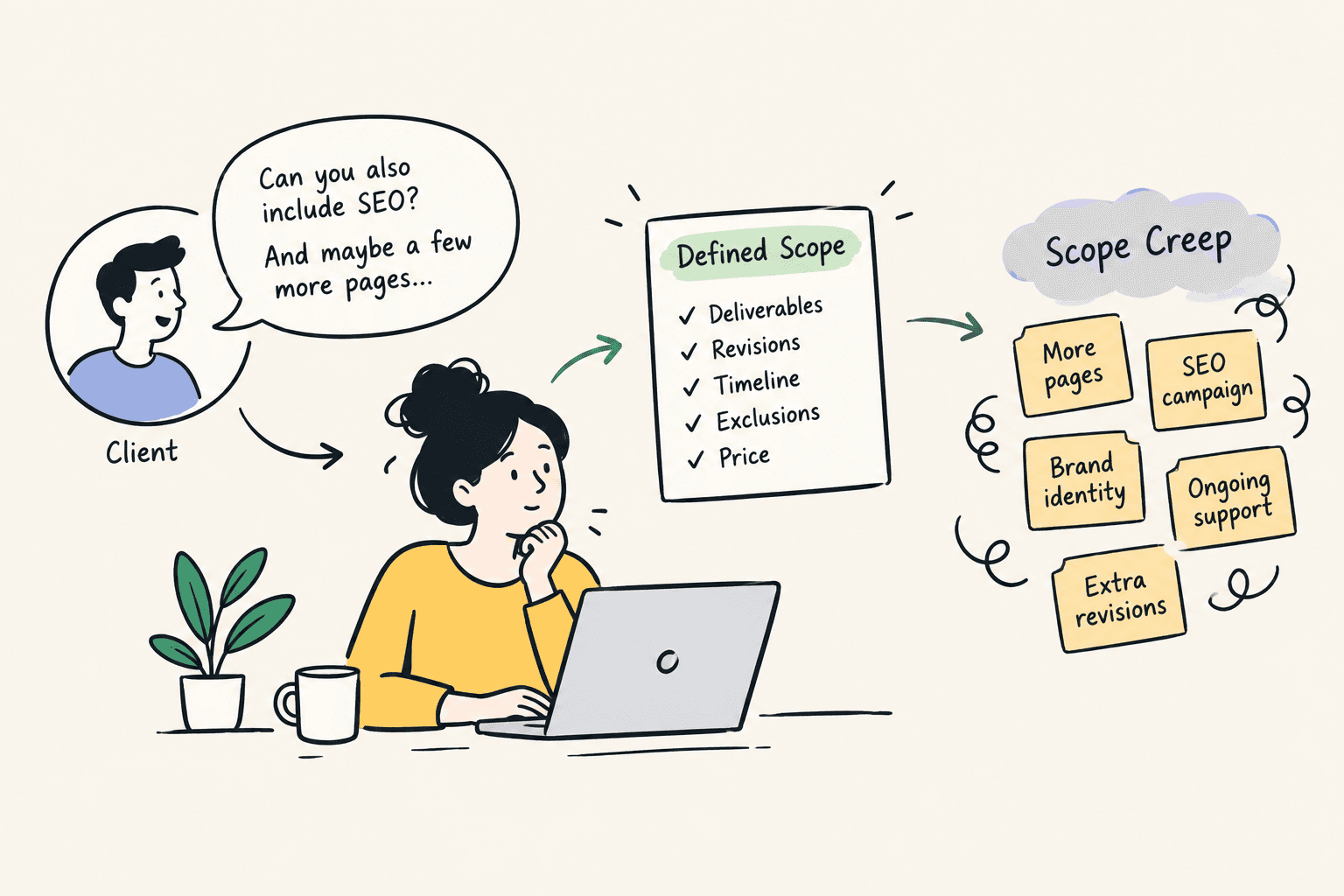
Scope creep rarely starts halfway through a freelance project.
It usually starts much earlier—with a vague sentence in a client's first email.
“Can you include some SEO too?”
Or:
“We might need a few more pages depending on what you recommend.”
Or:
“The site should be ready to launch by the end of the month.”
You read the message, understand roughly what the client wants, send a proposal, and start working.
A few weeks later, you're doing extra work that wasn't included in your original estimate.
The client may not even think they're asking for anything unreasonable. From their perspective, they're simply asking you to finish the project they hired you for.
The problem is that the project was never clearly defined in the first place.
That's what makes scope creep so dangerous for freelancers.
The good news is that preventing scope creep doesn't require a complicated project-management system. You can prevent many scope problems by catching ambiguity early, defining exactly what you're delivering, setting reasonable limits, and making it clear what isn't included.
Here's how to do it.
What Is Scope Creep in Freelance Projects?
Scope creep is the gradual expansion of a project's requirements beyond what was originally agreed upon.
For a freelancer, scope creep can look like:
- A five-page website becoming eight pages
- Two rounds of revisions becoming “just one more small change”
- Basic SEO turning into an ongoing SEO campaign
- A logo design turning into a complete brand identity
- Website development turning into hosting and maintenance
- “Set up analytics” turning into ongoing reporting
- A simple Shopify store turning into custom functionality
But scope creep isn't always caused by a difficult client.
Often, it happens because the freelancer and client have different interpretations of what the project includes.
That's why your proposal is one of your most important scope-management tools.
A good freelance proposal doesn't just help you win the project.
It defines what you're agreeing to deliver.
Why Does Scope Creep Happen?
Scope creep usually comes from one or more of these problems:
- The client's requirements are vague.
- Deliverables aren't clearly defined.
- The proposal doesn't specify what's excluded.
- Revision limits aren't established.
- The timeline doesn't account for client delays.
- New requests aren't treated as additional scope.
- The freelancer promises an outcome rather than a specific service.
- The client assumes certain work is “obviously included.”
In other words, scope creep often starts with unclear expectations.
Consider a client who says:
“We need a new website with SEO.”
What exactly does that mean?
It could mean installing an SEO plugin.
Or keyword research.
Or writing content.
Or technical SEO.
Or link building.
Or monthly SEO.
Or all of the above.
If your proposal simply says:
Website design + SEO — $3,500
you haven't really defined the scope.
You've created room for disagreement.
Identify Vague Client Requests Before Writing Your Proposal
One of the best ways to prevent scope creep is to analyze the client's original request before you start writing your proposal.
Look for vague phrases such as:
- “SEO”
- “optimization”
- “make it fast”
- “mobile-friendly”
- “a few pages”
- “minor changes”
- “basic maintenance”
- “social media”
- “help with content”
- “make it convert”
- “something similar to our competitor”
- “whatever is necessary”
- “we can figure that out later”
These phrases aren't necessarily red flags.
They're questions that need clarification.
Example: “Include SEO”
Imagine you're a freelance web designer and a client sends:
“We need a new five-page website and we'd also like you to include SEO so we can rank better on Google.”
If you quote:
Five-page website + SEO — $3,500
you've left yourself exposed.
Instead, break “SEO” into specific deliverables.
For example:
SEO included:
- Keyword research for up to 10 target keywords
- On-page optimization for up to 5 pages
- Meta titles and descriptions
- Image alt-text optimization
- XML sitemap setup
- Google Search Console setup
Not included:
- Ongoing SEO
- Link building
- Content writing
- Guaranteed rankings
- Monthly reporting
- Off-page SEO
Now both sides understand what “SEO” means.
That's the difference between selling a category and selling defined deliverables.
Price the List, Not the Hope
A useful rule for freelance proposals is:
Price the list, not the hope.
Don't price the project based on what you think the client probably means.
Price the specific work you're actually agreeing to do.
For example, instead of:
Website redesign — $4,000
define the project:
DeliverableIncludedHomepageDesign + developmentAbout pageDesign + developmentServices pageDesign + developmentContact pageDesign + developmentBlogSetup + templateMobile optimizationIncludedBasic on-page SEOUp to 5 pagesRevisions2 rounds
This makes the proposal easier for the client to understand and gives you something concrete to refer back to when a new request appears.
If the client later says:
“Can you also create three landing pages?”
you don't have to argue.
You can say:
“Happy to add those. The current proposal includes four core pages, so I can quote the three landing pages as an additional scope item.”
The conversation becomes about adding a deliverable, rather than debating whether you're being difficult.
Define Exactly What Each Deliverable Includes
“Website design” sounds specific until you try to determine what's actually included.
Does website design include:
- Wireframes?
- Desktop designs?
- Mobile designs?
- Development?
- Animations?
- Copywriting?
- Stock photography?
- Image editing?
- Accessibility work?
- SEO?
- Browser testing?
- CMS training?
You don't need to include all of these.
You need to decide which ones you're selling.
For example:
Website design includes: desktop and mobile layouts for five pages using client-provided copy and imagery.
That's much safer than:
Website design: Complete website design.
The more specific the deliverable, the less room there is for assumptions.
Use Numbers Whenever Possible
Compare:
“Several website pages”
with:
“Up to 5 website pages.”
Or:
“SEO optimization”
with:
“On-page SEO for up to 5 pages.”
Or:
“Revisions included”
with:
“Two rounds of revisions per design phase.”
Numbers turn vague expectations into boundaries.
Set a Clear Revision Limit
Unlimited revisions are one of the easiest ways for a profitable freelance project to become unprofitable.
A client might genuinely believe another revision is reasonable.
After all, you're already working on the design.
But every additional revision consumes time.
Instead, define your revision policy in the proposal.
For example:
Revisions: The project includes two rounds of revisions per design phase. Additional revisions are billed at $75/hour.
You can also specify how feedback should be provided:
The client will provide consolidated feedback for each revision round. Requests introduced after approval of a phase may be treated as additional work.
This isn't about being difficult.
It's about making the rules clear before the project begins.
Don't Let “Small Changes” Become Unlimited Work
Scope creep often hides behind the word small.
A client might say:
“It's just a small change.”
But “small” describes how the request feels to the client—not necessarily how long it takes you.
A seemingly minor request can require:
- Design changes
- Development changes
- Responsive adjustments
- Testing
- Client review
- Additional revisions
Instead of debating whether something is “small,” define your process.
For example:
Changes outside the agreed deliverables will be quoted separately before work begins.
Now the question isn't:
“Is this small enough to do for free?”
It's:
“Is this part of the agreed scope?”
That's a much better question.
Don't Promise Results You Can't Control
Scope creep isn't limited to additional tasks.
It can also happen when clients interpret an outcome as a promise.
Consider:
“We want to rank #1 on Google.”
If your proposal says:
SEO — Help client rank #1 on Google
you've created a potentially impossible expectation.
Search rankings depend on factors outside your control.
Instead, define the work you can actually deliver:
On-page SEO: Optimize up to five pages for agreed target keywords, including metadata, headings, internal linking, and basic technical setup.
You've turned an uncontrollable outcome into a measurable service.
This principle applies beyond SEO.
Instead of:
“Increase conversions.”
Use:
“Design and implement a new landing page based on the agreed conversion strategy.”
Instead of:
“Make the website fast.”
Use:
“Optimize images, implement caching, and address agreed performance issues.”
Instead of:
“Make the site accessible.”
Define the accessibility work and standard you're targeting.
The more measurable your promise, the easier the project is to manage.
Protect Your Timeline From Client Delays
Scope can expand because of client delays too.
Imagine you've promised:
Website launch: October 30
But the client doesn't provide final copy until October 20.
The original deadline hasn't changed—but the amount of production time available to you has.
Your proposal should explain what happens when required client inputs arrive late.
For example:
Project timelines assume that required content, assets, approvals, and feedback are provided according to the agreed schedule. Delays in client feedback or materials may move the project timeline accordingly.
You can make the process more specific:
If required client feedback is delayed, the project schedule may be adjusted to reflect the delay.
The exact terms should fit your business and contract, but the principle is simple:
Your deadline shouldn't remain fixed when the inputs required to meet it aren't available.
Clearly Define What's Not Included
Freelancers often spend a lot of time listing what they will do.
It's equally important to explain what they won't do.
For a website project, that might include:
Not included:
- Copywriting
- Professional photography
- Paid plugins
- Third-party subscriptions
- Advanced SEO
- Custom integrations
- Ongoing maintenance
- Additional pages
- Additional revision rounds
This section doesn't make your proposal look less valuable.
It makes the proposal more precise.
Think of it as a boundary around the project.
Use a Change Request Process for New Work
Even the best proposal won't prevent every change.
Clients will have new ideas.
Requirements will change.
Sometimes you'll happily agree to additional work.
The important thing is to make the change intentional.
A simple change-request process can look like this:
1. Identify the new request
Determine exactly what the client wants.
2. Compare it with the agreed scope
Ask:
Is this already included in the proposal?
3. Estimate the additional work
Determine the additional cost and timeline.
4. Get approval
Tell the client the additional price and any timeline impact.
5. Start the work
Only begin once the additional scope is approved.
For example:
“The three additional landing pages aren't included in the current scope. I can add them for $600, and they'll add approximately three working days to the timeline. If you'd like to proceed, I'll send over the updated scope.”
That's professional scope management.
A Simple Scope-Creep Checklist for Freelancers
Before sending a freelance proposal, run through this checklist.
Deliverables
- Is every major deliverable explicitly listed?
- Is the number of pages, screens, or features defined?
- Have vague services been broken into specific tasks?
- Are client responsibilities clearly identified?
Revisions
- How many revision rounds are included?
- What happens when additional revisions are requested?
- Does feedback need to be consolidated?
Timeline
- Is the project timeline defined?
- What happens if the client delays feedback?
- What content or assets must the client provide?
Pricing
- Does the price correspond to specific deliverables?
- Are additional services priced separately?
- Are third-party costs excluded?
Exclusions
- Have important exclusions been listed?
- Are potentially ambiguous services clearly limited?
Outcomes
- Are you promising work you control?
- Have you avoided guaranteeing results you can't control?
If you can answer these questions before sending the proposal, you've already eliminated many common sources of scope creep.
The Best Time to Catch Scope Creep Is Before You Send the Proposal
Here's the bigger lesson:
Scope creep isn't just a project-management problem. It's a proposal problem.
The first place to look for potential scope problems is often the client's original message.
That's where the ambiguity begins.
A client might send:
“We're looking for a new website, probably around 6–8 pages. We'd like it to be fast, SEO-friendly, and optimized for conversions. We also need help with Google. Ideally we'd like everything ready by November 1st. Let us know what you recommend.”
There's useful information in that message.
There's also a lot of uncertainty.
You need to identify:
- Is it six pages or eight?
- Who provides the copy?
- What does “SEO-friendly” mean?
- What does “help with Google” mean?
- What does “optimized for conversions” include?
- What happens if the client doesn't provide content?
- Is November 1st a hard deadline?
- How many revisions are expected?
You shouldn't simply turn that email into a polished proposal and assume the ambiguity has disappeared.
The ambiguity needs to be resolved first.
A Better Workflow for Freelance Proposals
A safer proposal workflow is:
Client inquiry → Identify ambiguity → Define scope → Price deliverables → Add boundaries → Send proposal
Not:
Client inquiry → Guess what they mean → Write proposal → Discover problems during the project
The first workflow gives you an opportunity to catch scope problems while they're still cheap to fix.
That's where an AI proposal assistant like Propoflow can help.
Instead of starting with a blank proposal, you can use the client's original inquiry as the starting point. Propoflow helps turn messy client requests into structured project information—including scope, deliverables, timelines, budgets, and potentially vague requirements.
That means you can review the request before committing to a scope, rather than discovering the ambiguity after you've already started working.
Try Propoflow Before You Send Your Next Proposal
Paste your next messy client inquiry into Propoflow and use it as a pre-proposal scope check.
Look for:
- Vague deliverables
- Missing requirements
- Open-ended requests
- Unclear timelines
- Potential scope-creep risks
- Assumptions that need clarification
Then turn the clarified requirements into a proposal you can confidently send.
Try Propoflow's free proposal maker →
The goal isn't to make every proposal longer.
It's to make the agreement clearer before the work begins.
The Goal Isn't to Eliminate Every Change
Scope control doesn't mean refusing every client request.
Clients will change their minds.
New ideas will appear.
Sometimes you'll happily do something extra because it's strategically useful or because the relationship matters.
The goal is to make those changes intentional.
If a client asks for three additional landing pages, you should be able to say:
“Sure. That's outside the current scope. I can add them for $600 and extend the timeline by three working days.”
The client can accept or decline.
Either way, everyone understands the tradeoff.
That's healthy scope management.
The unhealthy version is:
“Sure, I'll just do it.”
Followed by:
“And could you also…”
And then:
“One more thing…”
Until you've delivered twice the work for the same price.
Final Takeaway
Most scope creep doesn't begin with a client deliberately trying to get free work.
It begins with ambiguity.
A phrase like “include SEO,” “make it convert,” “a few more pages,” or “launch by the end of the month” can mean very different things to different people.
Your job as a freelancer isn't to predict what the client means.
It's to turn vague requests into specific agreements.
That means:
- Read the original client request carefully.
- Identify vague or open-ended requirements.
- Turn them into measurable deliverables.
- Define revision limits.
- Protect your timeline from client delays.
- List important exclusions.
- Price specific work—not assumptions.
- Treat genuinely new requests as new scope.
Do that consistently and your proposals become more than sales documents.
They become a boundary around the project.
And that boundary can be the difference between a $3,000 project that takes 30 hours and a $3,000 project that quietly consumes 60.
Catch the ambiguity before you send the proposal—not after you've started the work.
Ready to catch vague scope before it becomes scope creep?
Stop Scope Creep in Your Inquiries
Paste any raw client inquiry into PropoFlow to detect risk flags, generate transparent line items, and close higher-ticket deals.
Try PropoFlow Free →