
How Propoflow Saved 40+ Free Hours for a Freelance Designer
See how a freelance designer used Propoflow to catch a vague SEO request before it turned into 40+ hours of unpaid work—and how better proposal scoping can prevent costly scope creep.
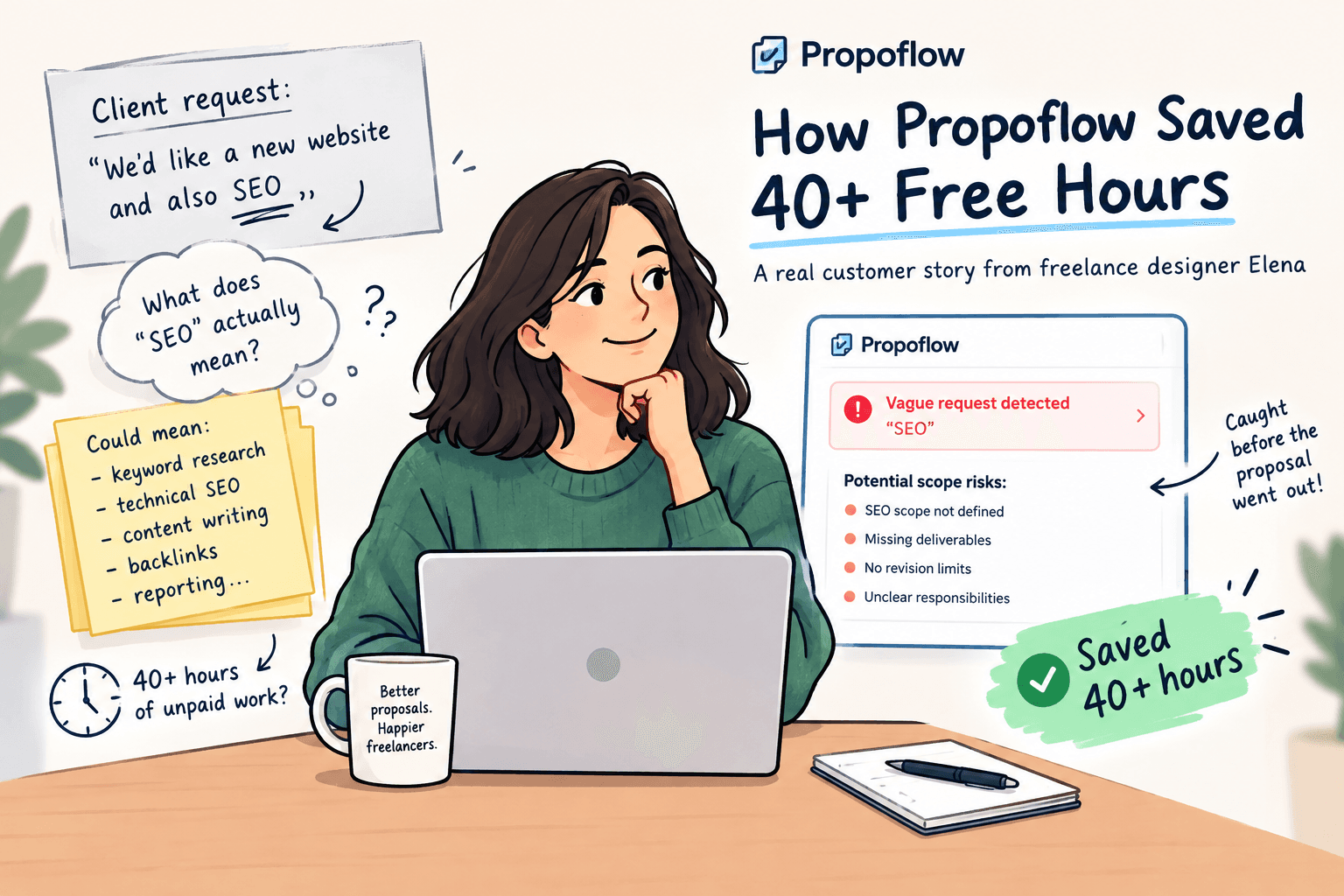
How Propoflow Saved 40+ Free Hours for a Freelance Designer
For freelancers, one vague sentence in a client request can turn into hours—or even days—of unpaid work.
That is exactly what happened to Elena, a freelance designer based in Berlin.
She was preparing a proposal for a client who wanted a new website and casually mentioned that they also wanted “SEO.” On the surface, it sounded like a small addition.
It wasn't.
Using Propoflow's scope-checking feature, Elena caught the vague request before she committed to it. What could have turned into weeks of unclear expectations and unpaid work was identified while she was still writing the proposal.
Her takeaway was simple:
“Propoflow caught an SEO request that would’ve meant 40 hours of unpaid work… that one proposal paid for the tool.”
This is Elena's story—and a good example of why proposal software can be about much more than making documents look professional.
The Problem: One Small Request Can Become 40 Hours of Work
Freelancers regularly receive requests that sound simple but hide a significant amount of work.
A client might say:
- “Can you include SEO?”
- “Make it rank on Google.”
- “Add analytics.”
- “We'll need a few rounds of revisions.”
- “Can you handle the content too?”
The problem isn't necessarily the request itself.
The problem is that the scope isn't clearly defined.
Take Elena's project.
The client wanted SEO included with the website. If Elena had simply written “SEO included” in the proposal, both sides could have walked away with completely different expectations.
The client might have expected keyword research, technical SEO, on-page optimization, metadata, content recommendations, Google Search Console setup, reporting, and ongoing optimization.
Elena may have intended to provide only basic on-page SEO.
That gap is where scope creep begins.
What Would Have Happened Without Propoflow?
Without identifying the ambiguity early, Elena could have accepted the project believing SEO was a relatively small addition.
Then the questions would start.
What keywords should be targeted?
Who is researching them?
How many pages need optimization?
Is technical SEO included?
Who creates the content?
Are backlinks part of the project?
Does “SEO” mean implementation or an ongoing service?
What happens if the client asks why rankings haven't improved?
None of those questions are necessarily unreasonable.
But they all represent additional work when the original proposal simply says “SEO.”
For Elena, that ambiguity could have translated into roughly 40 hours of unpaid work.
And unlike a missed opportunity, unpaid work is much harder to recover after the contract has already been agreed.
How Propoflow Caught the Risk
Elena used Propoflow while preparing the proposal.
The scope-check feature highlighted the vague SEO requirement, prompting her to look more closely at what the client was actually asking for.
That gave her an opportunity to define the work before sending the proposal.
Instead of treating “SEO” as an open-ended promise, she could establish a clear boundary around what was included.
For example:
Included:
- On-page SEO for the agreed website pages
- Page titles and meta descriptions
- Basic SEO structure recommendations
Not included:
- Ongoing SEO campaigns
- Link building
- Content writing
- Guaranteed search rankings
- Monthly SEO reporting
The exact scope will vary from project to project.
The important part is that both the freelancer and the client can see the same definition before the work begins.
The 40-Hour Difference
The real value of this kind of protection isn't just the time spent creating a better proposal.
It's the time you don't have to spend later.
Consider the difference:
Without clear scopeWith clear scopeClient says “SEO is included”SEO deliverables are definedExpectations remain unclearResponsibilities are explicitAdditional requests appear laterOut-of-scope requests are easier to identifyFreelancer may absorb extra workAdditional work can be quoted separatelyPotentially 40+ hours of unpaid workScope is agreed before work starts
In Elena's case, the cost of overlooking the vague request could have been enormous compared with the time needed to catch it during proposal creation.
That is why she described the experience this way:
“That one proposal paid for the tool.”
The Lesson for Freelancers
The lesson isn't that every client request is dangerous.
It's that vague language deserves attention before you agree to a project.
Experienced freelancers already know this.
They've probably learned it the hard way.
A client says “just a few changes.”
A website project suddenly needs ten additional pages.
“SEO” turns into a complete SEO campaign.
“Make it mobile-friendly” becomes testing across every device and browser imaginable.
The proposal is the moment when those assumptions can be turned into clear boundaries.
That makes proposal writing part of your project-management process—not just a sales document.
Why Catching Scope Problems Early Matters
It is much easier to negotiate scope before a client signs than after the project is underway.
Before the agreement, you can say:
“SEO isn't included as a full service, but I can include basic on-page optimization for the website.”
After the agreement, the conversation becomes:
“I thought SEO was included.”
Now you're negotiating against an expectation you helped create.
The earlier you identify unclear requirements, the easier it is to resolve them.
Propoflow Isn't Just About Better-Looking Proposals
A polished proposal is useful.
But a beautiful document with a vague scope can still create a bad project.
Propoflow is designed to help freelancers think through the proposal itself and identify unclear requirements before they become expensive problems.
That can mean catching:
Vague deliverables
Undefined services
Unclear client responsibilities
Missing boundaries
Potential scope creep
The result isn't just a more professional proposal.
It's a clearer agreement between you and your client.
What Could 40 Hours Mean for Your Business?
Forty hours is significant for a freelancer.
That's essentially a full workweek.
Depending on your rate, 40 hours of unpaid work could represent:
- $2,000 at $50/hour
- $3,000 at $75/hour
- $4,000 at $100/hour
- $6,000 at $150/hour
And that's before considering the opportunity cost.
Those hours could have gone toward another client, a new project, marketing, business development, or simply time away from work.
Preventing one badly scoped project can therefore have a much larger financial impact than the price of a proposal tool.
A Better Way to Write Proposals
A strong freelance proposal shouldn't only answer:
“Will the client hire me?”
It should also answer:
“Do we both understand exactly what I'm agreeing to do?”
Before sending your next proposal, look for phrases that sound harmless but could hide substantial work.
Words like:
“SEO”
“Design revisions”
“Support”
“Optimization”
“Setup”
“Content”
“Maintenance”
“Social media”
“Analytics”
“Integrations”
Whenever a service is mentioned without a clear definition, pause and ask:
What exactly is included?
That one question can prevent a lot of expensive misunderstandings.
Elena's Experience in One Sentence
Elena wasn't trying to avoid doing work for her client.
She was trying to make sure she didn't accidentally agree to 40 hours of work that nobody had actually defined or priced.
Propoflow helped her spot that risk while there was still time to fix it.
That's the real value of scope checking.
You don't use it because every client is difficult.
You use it because unclear expectations are expensive for everyone.
Start With 3 Free Proposals
You don't need to overhaul your entire proposal process to see whether this approach works for you.
Start with your next client project.
Write your proposal as usual, then use Propoflow to check the scope for vague or potentially risky requests before you send it.
You might catch something small.
Or you might catch something much bigger.
As Elena discovered, sometimes one proposal is enough to pay for the tool.
Try Propoflow with 3 free proposals and see what your next proposal reveals.
Stop Scope Creep in Your Inquiries
Paste any raw client inquiry into PropoFlow to detect risk flags, generate transparent line items, and close higher-ticket deals.
Try PropoFlow Free →