
Freelance Proposal Templates That Win Clients
Save time creating freelance proposals with ready-to-use templates for web design, SEO, Shopify, and more. Learn which sections to include, how to customize templates, and how to turn a template into a client-ready proposal.
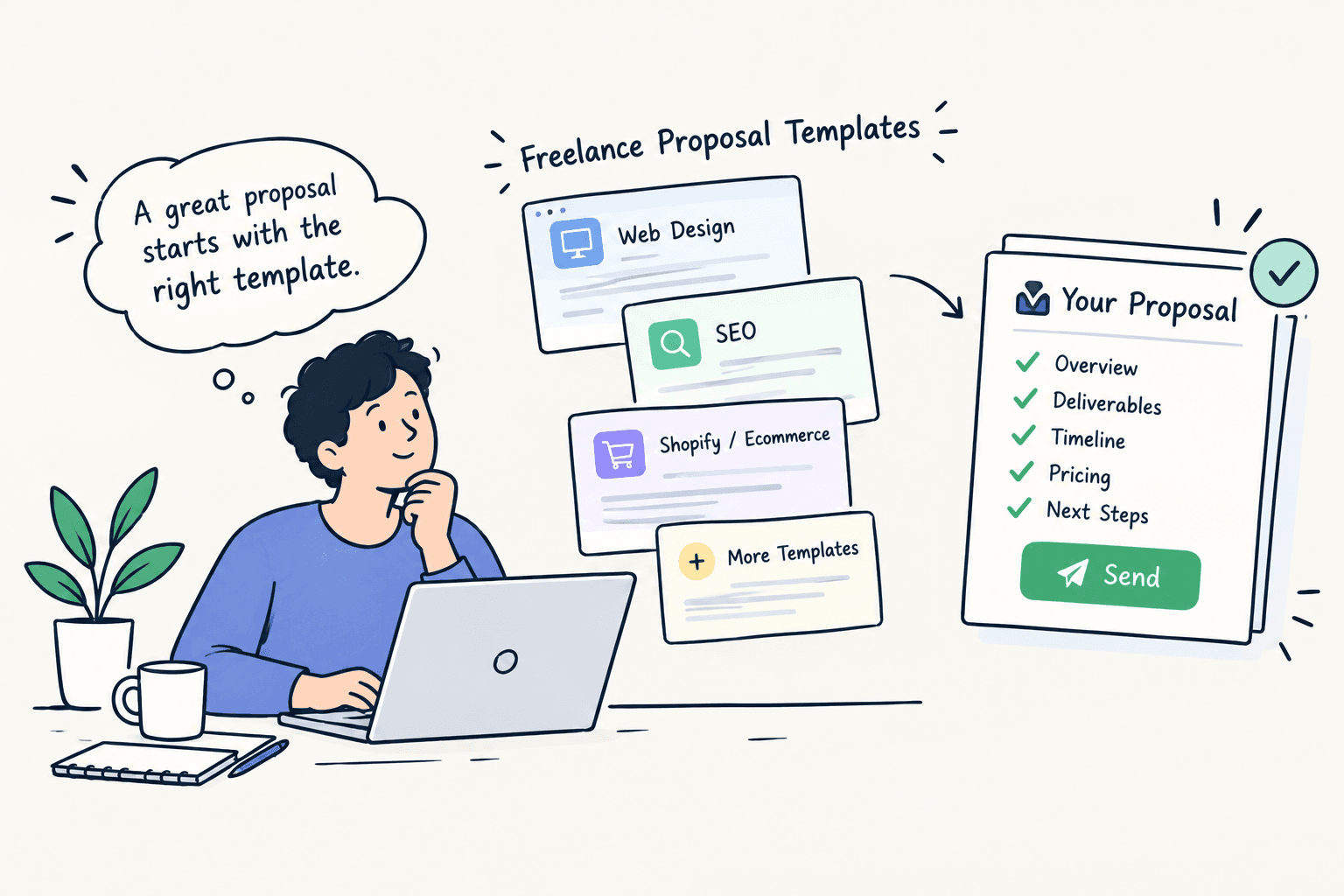
Freelance Proposal Templates That Win Clients
A blank proposal is one of the easiest ways to waste an hour as a freelancer.
You already know what you offer. You've probably written similar proposals before. Yet every time a new client says, "Send me a proposal," you're back in a blank document trying to decide what to include, what to leave out, and how to make it sound professional.
That's why a good freelance proposal template is so useful.
A template gives you the structure.
You add the client-specific details.
The important part is understanding that a template shouldn't make every proposal look identical. It should give you a reliable framework that you can quickly customize for the project in front of you.
What Should a Freelance Proposal Include?
A good proposal doesn't need to be long.
It needs to answer the questions the client is likely to have:
Do you understand what I need?
What exactly will I receive?
How will the project work?
How much will it cost?
What happens next?
A practical freelance proposal template usually includes these sections:
1. Project Overview
Briefly explain what you understand the client needs.
Don't start with a long biography about yourself. Start with the project.
Example:
Acme Labs is looking for a redesigned four-page website that presents its services more clearly, works well on mobile devices, and provides a stronger foundation for organic search.
This immediately tells the client that you understood the request.
2. Goals or Objectives
Explain what the project is intended to accomplish.
For a website, that might be improving usability, presenting services more clearly, or creating a stronger foundation for future growth.
For SEO, it might be improving technical health, targeting specific search terms, or increasing qualified organic traffic.
Keep this section focused. A proposal isn't the place to promise outcomes you can't control.
3. Deliverables
This is one of the most important sections.
Don't write:
Website design
Be specific.
Instead:
Four-page responsive website including homepage, services, about, and contact pages.
Specific deliverables make it easier for the client to understand the offer and easier for you to control the scope.
4. Process
Give the client a simple picture of how the project will happen.
For example:
Phase 1: Discovery and content planning
Phase 2: Design
Phase 3: Development
Phase 4: Review and launch
The client shouldn't have to guess what happens after accepting your proposal.
5. Timeline
Include the estimated duration and, where useful, milestones.
A single statement such as "Delivery in 4 weeks" is less useful than explaining what happens during those four weeks.
Also make client responsibilities clear. For example, delays in receiving content or feedback may affect the delivery date.
6. Pricing
Show the investment clearly.
For larger projects, a simple pricing table can make the proposal easier to understand.
7. Revisions
Define how many rounds of revisions are included.
For example:
Two rounds of revisions are included for each design phase. Additional revisions are billed separately.
This small section can prevent a lot of confusion later.
8. What's Not Included
This is often overlooked.
Listing exclusions helps both sides understand where the agreed scope ends.
Examples might include:
- Copywriting
- Stock photography
- Paid plugins
- Additional pages
- Custom integrations
- Ongoing maintenance
- Additional SEO work
9. Next Steps
Don't finish with:
Let me know what you think.
Tell the client exactly what to do.
For example:
To get started, approve the proposal and submit the 50% deposit. I'll then send the project kickoff questionnaire.
A clear next step removes unnecessary back-and-forth.
Freelance Proposal Template: Simple Structure
Here's a basic structure you can adapt to almost any freelance project:
FREELANCE PROPOSAL
Prepared for: [Client Name]
Prepared by: [Your Name]
Project: [Project Name]
Project Overview
[Brief description of the client's problem and what you're proposing to do.]
Goals
- [Goal 1]
- [Goal 2]
- [Goal 3]
Scope & Deliverables
- [Deliverable 1]
- [Deliverable 2]
- [Deliverable 3]
Process
Phase 1: [Description]
Phase 2: [Description]
Phase 3: [Description]
Timeline
[Estimated duration and milestones.]
Investment
Project total: $[Amount]
[Payment schedule or deposit terms.]
Revisions
[Number of included revision rounds.]
Not Included
[List important exclusions.]
Next Steps
[Exactly what the client needs to do to approve the project.]
This structure is intentionally simple.
You don't need a 10-page document for every $2,000 freelance project.
Web Design Proposal Template
Web design proposals usually need more detail around pages, functionality, revisions, and launch responsibilities.
Here's a simplified example.
Website Redesign Proposal
Project Overview
Acme Labs needs a modern four-page website that clearly communicates its services, works across desktop and mobile devices, and provides a stronger foundation for future marketing.
Scope
- Homepage
- Services page
- About page
- Contact page
- Responsive desktop and mobile layouts
- Contact form
- Basic on-page SEO setup
- Website deployment
Process
Week 1: Sitemap, content review, wireframes
Week 2: Homepage and visual direction
Week 3: Remaining page designs and development
Week 4: Revisions, testing, and launch
Revisions
Two rounds of revisions are included.
Not Included
- Copywriting
- Photography
- Paid third-party software
- Additional pages
- Advanced integrations
- Ongoing maintenance
Investment
$3,000
Next Step
Approve the proposal and submit the 50% deposit to schedule the project.
Notice how much clearer this is than simply writing:
Website redesign — $3,000
The client can see what they're actually buying.
SEO Freelancer Proposal Template
SEO proposals need a slightly different structure because SEO work can easily become vague.
Instead of saying:
SEO services — $1,000/month
define exactly what you're doing.
SEO Proposal
Project Overview
Acme Labs wants to improve its organic visibility for commercial search terms related to its services.
Initial Scope
- Technical SEO audit
- Keyword research for up to 20 target terms
- On-page optimization for 5 priority pages
- Metadata optimization
- Internal-linking recommendations
- XML sitemap and indexing review
- Monthly performance report
Not Included
- Link building
- Content writing
- Paid advertising
- Guaranteed rankings
- Unlimited page optimization
Timeline
Month 1: Audit and keyword research
Month 2: On-page implementation
Month 3: Optimization and reporting
Investment
$1,000/month
This approach is particularly important for services where one word can hide a huge amount of work.
"SEO" can mean five different things to five different clients.
Your proposal should define what it means for this particular project.
Shopify Proposal Template
Ecommerce projects also benefit from very specific deliverables.
Shopify Store Proposal
Project Overview
Build and launch a Shopify store for [Client Name] focused on presenting the product range clearly and providing a straightforward purchasing experience.
Scope
- Shopify theme setup and customization
- Homepage
- Collection templates
- Product page customization
- Cart and checkout configuration
- Up to 20 product uploads
- Payment gateway setup
- Mobile optimization
- Basic analytics setup
Not Included
- Product photography
- Product copywriting
- Custom app development
- Paid Shopify apps
- Ongoing store management
Timeline
Approximately 3–4 weeks from receipt of all required content and product information.
Investment
$X,XXX
Again, specificity is doing most of the work.
Don't Make Your Template Too Generic
One of the biggest mistakes freelancers make is creating one proposal template and barely changing it.
A template should save time, not remove personalization.
Compare these two openings:
"Thank you for considering our company. We are a full-service digital agency with extensive experience..."
and:
"Based on our conversation, you need a four-page website that makes your services easier to understand and gives you a stronger foundation for SEO."
The second version immediately connects the proposal to the client's situation.
That's what your template should help you do.
The structure stays consistent.
The content changes.
Customize the Template Around the Service
A useful way to build your proposal system is to create a few specialized templates rather than one giant generic template.
For example:
Web Design Proposal
Focus on pages, functionality, content, responsive design, revisions, and launch.
Shopify Proposal
Focus on store setup, products, theme customization, payments, apps, and ecommerce functionality.
SEO Proposal
Focus on audits, keywords, pages, technical work, reporting, and clear exclusions.
Brand Design Proposal
Focus on research, concepts, revisions, final assets, file formats, and usage.
Development Proposal
Focus on features, technology, integrations, testing, deployment, and maintenance.
You shouldn't have to rebuild your proposal structure every time a lead arrives.
Create the structure once.
Then customize the parts that actually matter.
Free Freelance Proposal Templates: What to Look For
When choosing a template, don't judge it by how beautiful the cover page looks.
Look for a template that makes important information easy to find.
A useful template should give you clear places for:
Project overview → Scope → Deliverables → Timeline → Pricing → Revisions → Exclusions → Next step
Modern proposal tools also increasingly combine templates with AI, e-signatures, payment collection, and other workflow features.
But those features shouldn't distract from the fundamentals.
A beautifully designed proposal with vague scope is still a vague proposal.
From Template to Finished Proposal
The real advantage of templates isn't that they write the entire proposal for you.
It's that they remove the repetitive work.
Instead of starting here:
Blank document → What do I write?
you start here:
Template → Client details → Scope → Pricing → Review → Send
And tools that can start from the client's original inquiry can reduce the manual work even further.
That's the workflow Propoflow is designed around.
Instead of choosing a template and manually typing all the project information into it, you can start with the client's actual message.
Propoflow helps turn that messy inquiry into structured information such as scope, deliverables, timeline, and budget, which you can then review and turn into a proposal.
So the workflow becomes:
Client inquiry → Structured scope → Proposal template → Review → Send
That means your template becomes a starting point rather than another document you have to fill out from scratch.
Where to Find Freelance Proposal Templates
You don't need to create every template yourself.
You can start with a basic structure, customize it for your service, and then save it for future projects.
Propoflow provides proposal templates designed around common freelance services, including web design, SEO, and ecommerce, so you can start from a relevant structure rather than a completely blank page.
The important thing is to customize the template around the actual client.
A template should provide the framework.
Your proposal should still sound like it was created specifically for that client.
Final Takeaway
A good freelance proposal template does three things:
It saves you time.
It makes your proposal easier for the client to understand.
It helps you define exactly what you're agreeing to deliver.
The best template isn't necessarily the longest or most visually impressive one.
It's the one that gives you a repeatable structure while leaving enough room to make every proposal relevant to the project.
Start with a clear overview, define the deliverables, explain the process, show the price, set boundaries, and finish with one clear next step.
Then let your tools handle as much of the repetitive work as possible.
Start With a Free Proposal Template
Don't build your next proposal from a blank document.
Start with a template, adapt it to your service, and make it specific to the client.
Browse Propoflow's free proposal templates for web design, SEO, ecommerce, and more.
Stop Scope Creep in Your Inquiries
Paste any raw client inquiry into PropoFlow to detect risk flags, generate transparent line items, and close higher-ticket deals.
Try PropoFlow Free →